The problem
What is Fund Alpha — and why does it matter?
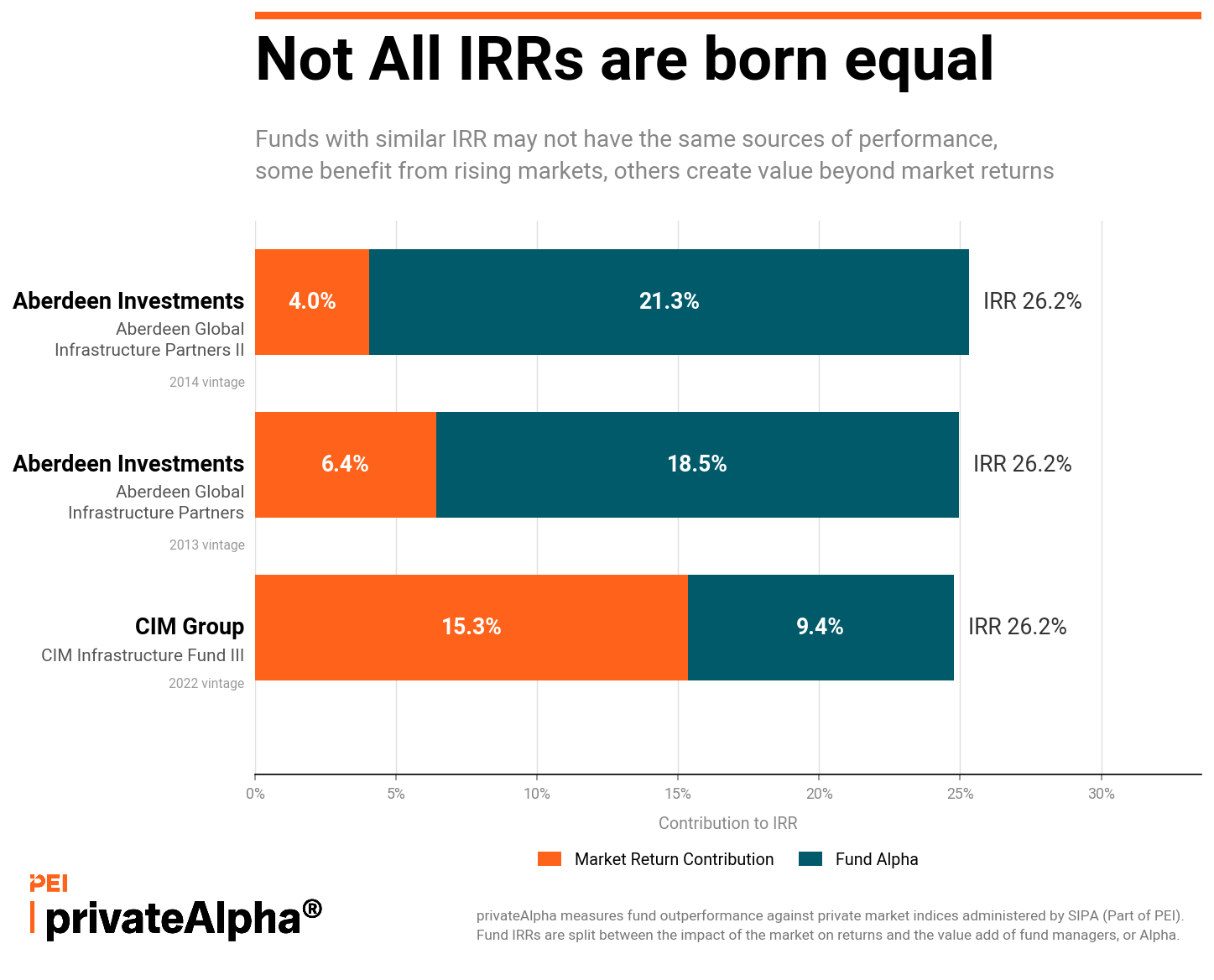
An IRR tells an investor what a fund returned. It does not say how much of that came from the market and how much the manager added. privateAlpha separates the two using the Direct Alpha Method: every cash flow is restated at the market's own return from the date it occurred, so the result is an annualised rate at which the fund beat or lagged its benchmark — not a return figure that blends market movement with manager skill.
Measured against the broad market, this is Total Alpha. Measured against a benchmark matched to the fund's own declared strategy, sector, and region, it is Pure Alpha — the genuine, manager-generated outperformance, and the metric privateAlpha ranks funds and GPs on.
On average, buyout funds do not beat the market (average net alpha vs. SIPA indices is zero) — this is the proof that SIPA indices genuinely represent the market. Many individual managers do beat it, some repeatedly. privateAlpha identifies who they are, and weights each fund's contribution to a GP's rank by how much of its result has been realised in cash rather than held at appraisal — its DPI relative to TVPI.
TOTAL ALPHA
vs. infra300® / private2000® Index
Return above the whole market — the broad private infrastructure or private equity index, the only benchmark built entirely from private market transaction data, ESMA-registered and recalibrated monthly.
ALLOCATION ALPHA
The strategy and sector tilt
Total Alpha less Pure Alpha — the part of a fund's return that came from where the manager chose to invest, by sector, geography, and strategy, rather than from how well it invested there.
PURE ALPHA
The ranked metric
Return above a benchmark matched to the fund's own strategy — the residual not explained by the market or by allocation. Computed using the Direct Alpha Method and expressed in annualised basis points — the true measure of GP skill.